Nantes Train Station
Nantes train station is the rail gateway to the city of Nantes in the Loire-Atlantique department of the Pays de la Loire region in western France. This guide covers the Paris connection, the transport that meets arriving trains, the airport shuttle and the day trips that start from the same platforms.

Short answer
Nantes train station, the city's main station in western France, is linked to Paris Montparnasse by about 24 direct trains a day in each direction, with the fastest journeys taking about two hours. Trams and buses of the Naolib network meet arriving services, a 10 euro airport shuttle runs from the adjacent Gare routière, and TER trains reach Clisson, Saint-Nazaire, La Baule and Rennes in well under two hours.
Nantes train station, the main railway station of the city of Nantes in the Loire-Atlantique department of the Pays de la Loire region of western France, is the point where many arriving travellers first touch the city's pavement. It is a through station rather than a terminus, and almost everything a traveller needs, trams, buses, the airport shuttle and the riverside of the Loire, sits within a short stretch of the same district. The station is the hub of a network that stretches from Paris Montparnasse in the east to the Atlantic beaches of La Baule and Le Croisic in the west, and it handles a volume of direct capital-city trains that many regional French stations would envy. This guide explains what the station connects to, how the local transport meets arriving services, what the airport shuttle costs and which day trips you can run from the same platforms without ever moving your luggage far.
Where Is Nantes Train Station And What Is It Called?
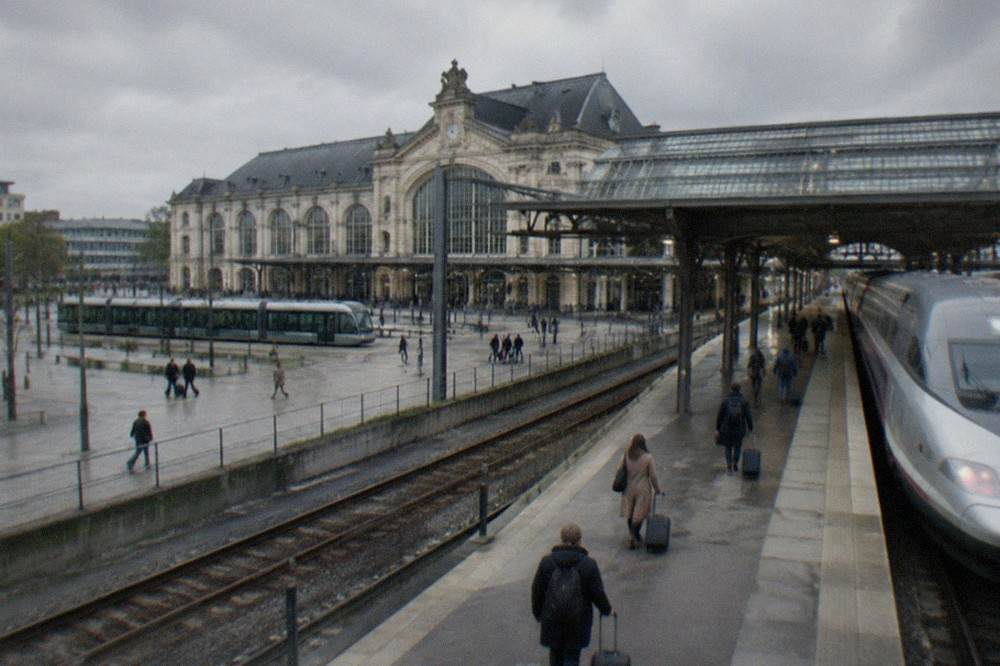
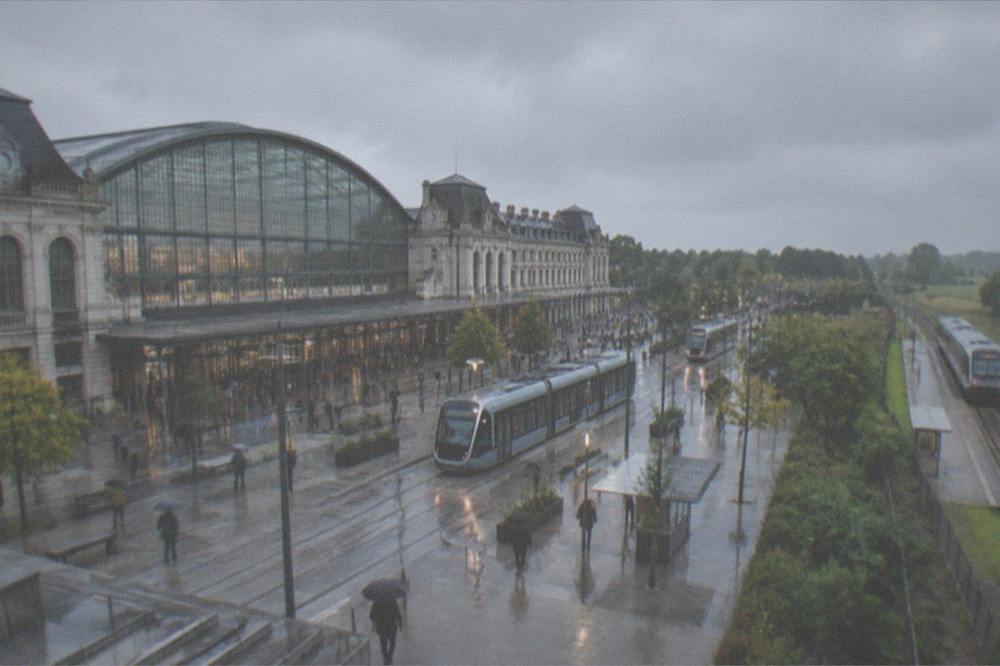
The station is called Gare de Nantes, and it is the principal railway station of the city of Nantes, in the Loire-Atlantique department of the Pays de la Loire region of western France. Long-distance trains from Paris, regional TER services and the city's tram and bus network all converge here, which makes it both a rail hub and a local interchange. Visitors arriving in Nantes by train will pass through this station, whether they come from the capital, from Rennes or from the coast.
The naming is simpler than in many French cities. There is one main station serving long-distance and regional traffic, so a ticket marked simply "Nantes" will bring you here. The station sits on the south bank side of the city's transport spine, and the Naolib network treats it as one of its principal interchange points: the tram lines that cross the city stop within the station complex itself, so the transfer from platform to tram involves no separate ticket purchase beyond the one you buy on arrival.
That interchange quality is what defines the station for most travellers. Unlike stations stranded on a city's edge, Nantes train station feeds directly into the public transport grid. The green line of Le Voyage à Nantes, the painted trail that threads through the city's sights, begins its route within easy reach of the station district, and the trail is a good first walk for anyone with a free afternoon after arrival. For a wider view of what the city offers once you have dropped your bags, the things to do in Nantes page is the site's main overview.
What the station is not, is a destination in itself. There is no observation deck, no museum and no famous architecture to queue for. It is a working interchange, and the value in understanding it lies entirely in the connections: which trains use it, what transport meets it, and how quickly you can be standing somewhere worth photographing. The rest of this guide works through those connections in the order a visitor actually meets them, starting with the long-distance link that brings most people here in the first place. The city itself repays the stop, as the is Nantes worth visiting question is usually answered with a yes by the time the first evening ends.
How Long Is The Train From Paris To Nantes Train Station?
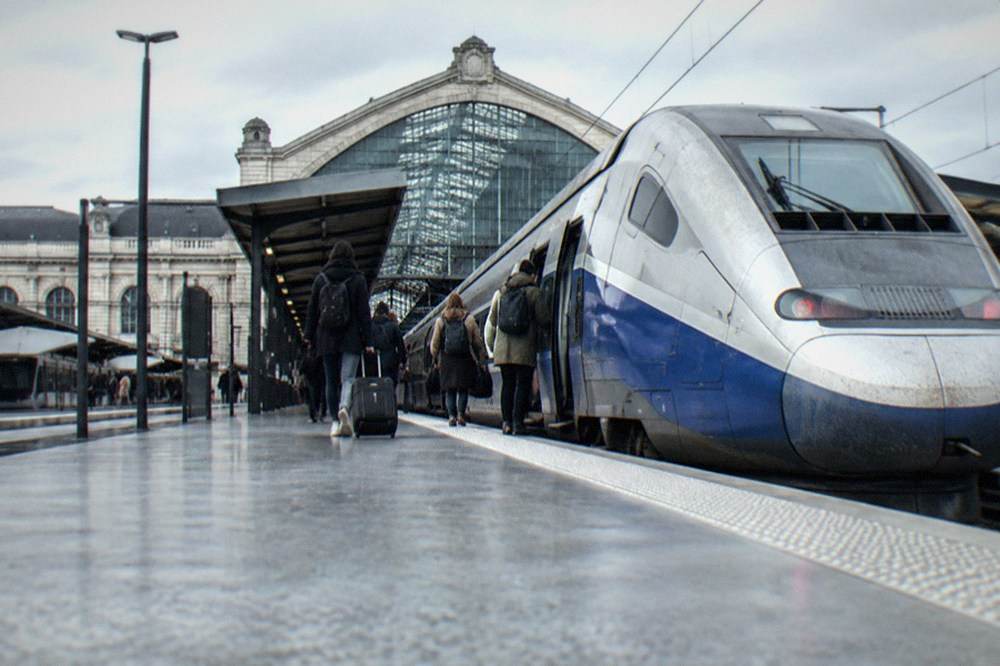
Trains from Paris to Nantes run about 24 times a day in each direction, and the fastest direct services take about two hours between Paris Montparnasse and Nantes. Current timetables show first departures from Nantes at around five in the morning and last departures at around eight in the evening, which means the capital is comfortably reachable as a day trip in either direction. Most services are direct, with no change of train required along the way.
The route is one of the busiest in western France, and it splits between the premium TGV services into Paris Montparnasse and lower-cost OUIGO services, some of which serve Paris Austerlitz or run via Massy. The practical difference for a visitor is usually the departure station in Paris and the flexibility of the ticket rather than the arrival point, since both families of service arrive at the same platforms in Nantes. A fuller treatment of the capital-to-Nantes journey, including what to expect on board, is in the dedicated Paris to Nantes guide, and the question of ticket prices is handled separately in how much is a train from Paris to Nantes.
| Paris to Nantes rail link | What the timetables show |
|---|---|
| Trains per day, each direction | About 24 |
| Fastest journey time | About two hours |
| Main Paris terminus | Paris Montparnasse |
| Other Paris services | OUIGO to Paris Austerlitz, some via Massy |
| First morning departure from Nantes | Around 05:08 |
| Last evening departure from Nantes | Around 20:09 |
Two practical notes matter more than any headline number. The first is that "about two hours" is a range, not a promise: individual services vary, and the SNCF Connect timetables, which the figures in the table above summarise, are the live authority on any given date. The second is that frequency cuts both ways. With roughly two dozen departures a day, a missed train is an inconvenience rather than a crisis, but the last services of the evening do leave a genuine gap overnight, so a late arrival into Paris Montparnasse can mean an early start the next morning rather than a quick dash back to Nantes.
For visitors building an itinerary around the rail link, the seasonal question also deserves a thought. The best time to visit Nantes guide explains how the city changes across the year, and summer weekends in particular see the Paris-Nantes trains fill with coast-bound traffic, since the same line continues toward Saint-Nazaire and the beaches beyond. Booking ahead on summer weekends is the single most useful thing you can do with this connection.
If your train ride is only the first leg of a longer stay, the way you spend your first hours in the city can set the tone for the whole visit, and a guided start is one option worth weighing alongside doing it alone.
What Transport Connects Nantes Train Station To The City Centre?
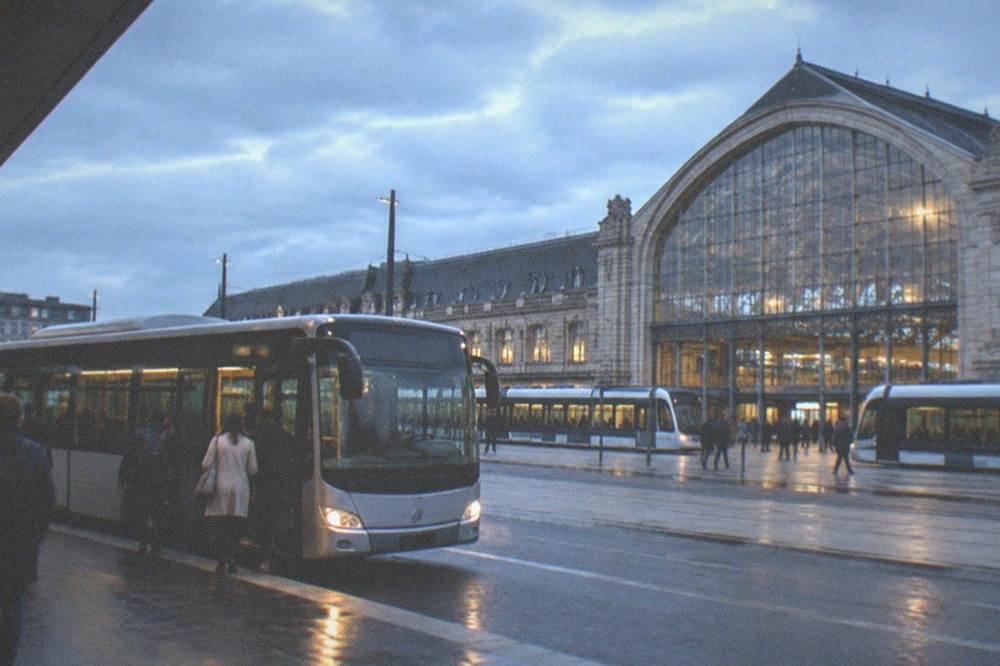
The Naolib network, Nantes's tram, bus and river-bus system, meets arriving trains at the station, and a single one-hour ticket costs 1.80 euro, covering trams, buses, the Navibus river shuttles and even TER trains inside the metropole perimeter. A 24-hour ticket costs 6.80 euro, and a 24-hour ticket for up to four people travelling together costs 15 euro. Tickets are bought before boarding and validated on the vehicle.
The tram network is the backbone. Three tram lines, running to 45.6 kilometres of track across 84 stations, plus the busway line 4, thread through the station complex and out to the districts visitors actually want: the Bouffay old town, the Graslin quarter with the Passage Pommeraye, the Île de Nantes and the Machines de l'île, and the riverside at Trentemoult across the Loire. The network carried 154 million trips in 2024, which gives a sense of how ordinary, and how frequent, these services are for the city that uses them daily.
| Naolib ticket | Price | What it covers |
|---|---|---|
| 1-hour single ticket | 1.80 euro | Tram, bus, Navibus and TER inside the metropole perimeter |
| Carnet of 10 x 1-hour tickets | 17.80 euro | Ten single journeys, shareable within the validity rules |
| 24-hour ticket | 6.80 euro | Unlimited network travel for one person |
| 24-hour ticket for 4 people | 15 euro | Unlimited travel for up to four travelling together |
| Weekend travel | Free | Saturdays 00:00 to Sundays 23:59, everyone, airport shuttle excluded |
The weekend rule deserves its own sentence, because it is genuinely unusual and easy to miss. Naolib's own fare pages state that the whole network, trams, buses, Navibus river shuttles and the TER trains inside the agglomeration, is free for absolutely everyone from midnight at the start of Saturday until 23:59 on Sunday, a policy reported as running since 2021. The airport shuttle is the one deliberate exception: it always costs 10 euro, weekends included, a distinction the fare page makes explicitly. Park-and-ride car parks are also free at the weekend when combined with network use, subject to validation and a 24-hour maximum.
For many visitors, though, the honest summary is simpler still: arriving at Nantes train station and reaching the centre is a single-ticket exercise, and the walkable core of the city is compact enough that plenty of people never take a second tram. The full transport picture, including the river buses and the bike-share scheme, is in getting around Nantes, and the practical safety picture for the station district and the city at large is covered in the is Nantes safe guide.
A private guide can turn that first transfer into something more useful than a tram ride, meeting you in the station district and walking you straight into the old town with the history attached.

How Does The Airport Shuttle Work From Nantes Train Station?
The Navette Aéroport, Nantes's airport shuttle, costs 10 euro for a single journey, takes about 20 minutes between the station district and Nantes Atlantique airport, and its city stop moved on 30 March 2026 to the Gare routière at Gare Sud, quai A, directly beside the main station. It runs roughly every 20 minutes from April to October and every 30 minutes from November to March, operating from around 4:30 in the morning until midnight.
The shuttle is the standard answer to the airport question because Nantes Atlantique has no rail link of its own. The ticket is bought on board by bank card, is free for children under six, and includes something most airport buses do not: an hour of validity on the entire Naolib network, trams, buses and TER inside the metropole, so the shuttle fare doubles as your onward connection. The Nantes airport guide covers the terminal itself, and the full door-to-city transfer is broken down in Nantes airport to city centre.
| Airport shuttle detail | What the service gives |
|---|---|
| Fare, one way | 10 euro |
| Children under 6 | Free |
| Journey time, station to airport | About 20 minutes |
| Frequency, April to October | Every 20 minutes |
| Frequency, November to March | Every 30 minutes |
| Operating span | Roughly 04:30 to midnight |
| City stop since 30 March 2026 | Gare routière, Gare Sud, quai A |
| Weekend free travel | Not included, always 10 euro |
Two cautions prevent the common mistakes. The first is the weekend trap described earlier: because the city's transport is free from Saturday morning to Sunday night, visitors reasonably assume the airport bus must be too, and the fare pages state plainly that it is not. The second is the stop itself: the shuttle no longer uses its older city stopping point, having moved to quai A of the Gare routière at the end of March 2026, so any directions cached from before that date point to the wrong place. The shuttle also pauses on 1 May. More of these guides are collected on Nantes Travel Guide.
The airport it serves is a substantial operation, reported at around 7.19 million passengers in 2025, with new long-haul routes including a seasonal Air Canada service to Montreal from June 2026. For travellers weighing plane against train into Nantes, the flights to Nantes guide compares the options, and for UK visitors the question of which airports serve the city has its own answer on this site. The short version for this guide: if you fly, you will meet this shuttle, and it is a 10 euro, twenty-minute, every-twenty-minutes proposition, which compares well with airport transfers in most French cities of this size.
Which Day Trips Start From Nantes Train Station?
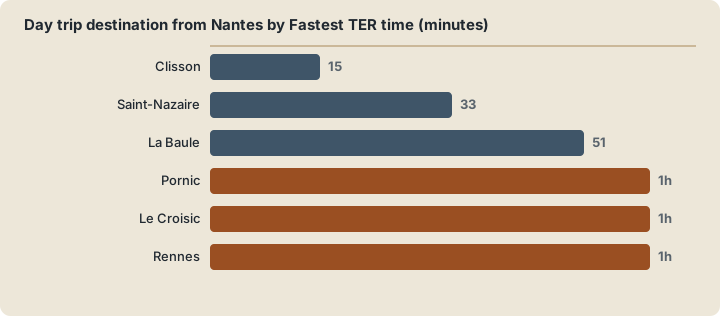
Regional TER trains from Nantes reach Clisson in about 15 minutes at their fastest, Saint-Nazaire in about 33 minutes, La Baule in about 51 minutes and Rennes in about 1 hour 16 minutes, with coastal Pornic around an hour and Le Croisic just over an hour away. All of these are direct regional services from the same station that serves Paris, so a day trip needs no transfer, no car and no second ticket office.
That spread is the station's quiet superpower. Within about an hour of stepping off a Paris train you can be standing on the beach at La Baule, walking the medieval lanes of Clisson or watching shipyard cranes at Saint-Nazaire, and every one of those journeys starts from the platforms you arrive at. Each of those destinations, along with the wider coastal and inland options, has its own dedicated write-up elsewhere on this site, from the vineyards of the Muscadet country around Clisson to the shipyard tours of Saint-Nazaire and the long crescent of sand at La Baule.
| Day trip destination from Nantes | Fastest TER time | What it is known for |
|---|---|---|
| Clisson | About 15 minutes | Medieval town, Italianate château, riverside |
| Saint-Nazaire | About 33 minutes | Shipyard city, Escal'Atlantic liner experience |
| La Baule | About 51 minutes | Long sandy beach resort |
| Pornic | About 1 hour | Seaside port and coastal walks |
| Le Croisic | About 1 hour 3 minutes | Fishing port and rocky coast |
| Rennes | About 1 hour 16 minutes | Breton capital, historic centre |
One ticketing detail makes Clisson especially easy: the municipal Pass Nantes, described in the next section, includes one TER return journey between Nantes and Clisson in its price, so a pass-holder's day trip to the medieval town costs nothing extra in rail fare. The TER network also feeds the wider Pays de la Loire region, whose vineyards and châteaux stretch beyond the rail lines, though those usually want a car.
A food-focused day or evening is equally reachable from the station district. The old town's restaurants sit within the walkable core of the city, covering everything from beurre blanc to the LU biscuit heritage, and an all-inclusive guided food walk is one way to compress several of the city's specialities into a single afternoon that starts and ends within easy reach of the station.
Where Should You Stay Near Nantes Train Station?
The practical answer is that you rarely need to stay beside the station at all. Because the tram network meets the station and the walkable core is compact, sleeping in the Bouffay or Graslin quarters and riding one or two stops, or walking, to catch a morning train is a practical option. The trade-offs between the station district, the old town and the Île de Nantes are laid out in the dedicated where to stay in Nantes guide.
The station district's appeal is functional: early departures, late arrivals and the airport shuttle at the door. Its drawback, as with most French station quarters, is that the immediate surroundings are dominated by transport rather than by the restaurants and squares people come to Nantes for. A new budget hotel did open on the Île de Nantes in January 2026, part of a wave of investment around the former docklands, which widens the mid-range options between the station and the river.
The honest framing is by journey type. If you are in Nantes for one night between two trains, the station district is the rational choice. If you are in the city for two or three days, the sweet spot for most itineraries, the old town wins on atmosphere and the walk to morning coffee. Families have a separate set of trade-offs again, and anyone watching costs will find the comparison in Nantes on a budget.
One cost that surprises some visitors is the city's tourist tax, charged per person per night on top of the room rate and tiered by the hotel's official star rating: reported rates run at 2.86 euro at four stars, 1.87 euro at three stars and 1.10 euro at two stars, with unclassified accommodation charged as a percentage of the nightly price instead. It is a small line on the bill, but it is worth knowing it exists before the front desk explains it.

Is A Pass Nantes Worth It For Visitors Arriving By Train?
The Pass Nantes, priced from 30 euro for 24 hours up to 75 euro for seven days for a full-rate adult, bundles unlimited Naolib transport, a return trip on the airport shuttle, a TER return to Clisson and one entry to each partner site including the château museum and the Galerie des Machines. For a visitor arriving at the station and intending to see several paying sights, the arithmetic can work in its favour.
The pass is aimed squarely at the rail arrival. It is sold in 24, 48 and 72-hour and seven-day versions, with reduced rates for 4 to 17-year-olds, students under 26 and disability card holders, and a family rate covering two adults and two children in which the second child's pass is free. Children under four do not need one at all. The Pass Nantes guide breaks the bundle down in full.
| Pass Nantes | Full rate | Reduced rate | Family, 2 adults and 2 children |
|---|---|---|---|
| 24 hours | 30 euro | 20 euro | 80 euro |
| 48 hours | 40 euro | 26 euro | 106 euro |
| 72 hours | 49 euro | 31 euro | 129 euro |
| 7 days | 75 euro | 45 euro | 195 euro |
What the pass does not include matters as much as what it does. The Grand Éléphant ride at Les Machines de l'île is explicitly excluded even though the Galerie and the Carrousel are covered, and elephant rides are in any case suspended for maintenance from 2 November 2026 to 28 February 2027. Some partner activities require a reservation rather than simple turn-up entry. The natural history museum, closed for a multi-year renovation until 2029, is naturally absent from the inclusion list while its doors are shut.
Whether the pass beats individual tickets depends on your pace. A slow traveller who visits one paying museum a day will likely lose money on it; a fast one who stacks the château museum, the Machines site and a Clisson day trip will likely come out ahead, especially counting the airport shuttle return. The trade-offs for cost-conscious visitors generally are worked through in free things to do in Nantes, since the city's centre is unusually generous with free sights, from the cathedral to the green line trail itself.
A sightseeing pass sold through tour operators covers a similar bundle of the city's headline attractions and transport, and is worth comparing against the municipal version.
The single most useful habit, whichever way you pay, is to decide your first day before your train pulls in. The station gives you everything needed for a fast start: trams at the platform, the old town in walking distance, and day trips from the same concourse.

Common Questions About Nantes Train Station
How long is the train from Paris to Nantes?
About two hours on the fastest direct services, with around 24 trains a day in each direction between Paris Montparnasse and Nantes. Most services are direct, and timetables show first departures from Nantes at around five in the morning and last departures at around eight in the evening.
Is Nantes train station the same as Gare de Nantes?
Yes. Gare de Nantes is the city's principal station, and it is the station every Paris, TER and coastal train uses. A ticket marked simply "Nantes" arrives here, and the tram and bus network meets the station directly.
How much is a ticket from Nantes train station to the airport?
The Navette Aéroport shuttle costs 10 euro one way, takes about 20 minutes and runs every 20 minutes from April to October, every 30 minutes the rest of the year. Children under six travel free, and the ticket includes an hour of validity on the wider Naolib network.
Is public transport free on weekends in Nantes?
Yes, from midnight at the start of Saturday until 23:59 on Sunday the whole Naolib network, trams, buses, Navibus and TER inside the metropole perimeter, is free for everyone including visitors. The airport shuttle is the exception and always costs 10 euro.
Which day trips can you do from Nantes train station?
Clisson in about 15 minutes at the fastest, Saint-Nazaire in about 33 minutes, La Baule in about 51 minutes, Pornic in around an hour, Le Croisic in about an hour and three minutes, and Rennes in about an hour and sixteen minutes, all by direct TER train from the main station.
Do you need to book Paris trains in advance?
The timetable runs about two dozen services a day, so a missed train is rarely a disaster, but summer weekends fill up as coast-bound traffic joins the line. Checking live availability on the rail operator's own booking site for your travel date is the reliable approach.
The station itself is only infrastructure, but it is the piece of infrastructure that decides how the rest of a trip feels: about two hours from Paris, a 1.80 euro tram from the old town, a 10 euro shuttle from the airport, and a shelf of coastal and Breton towns within a TER ride. Plan the arrival and the city opens quickly, and as Nantes Travel Guide covers in its neighbourhood pages, the districts worth sleeping in all sit within a couple of stops of the same platforms.