Anneaux De Buren
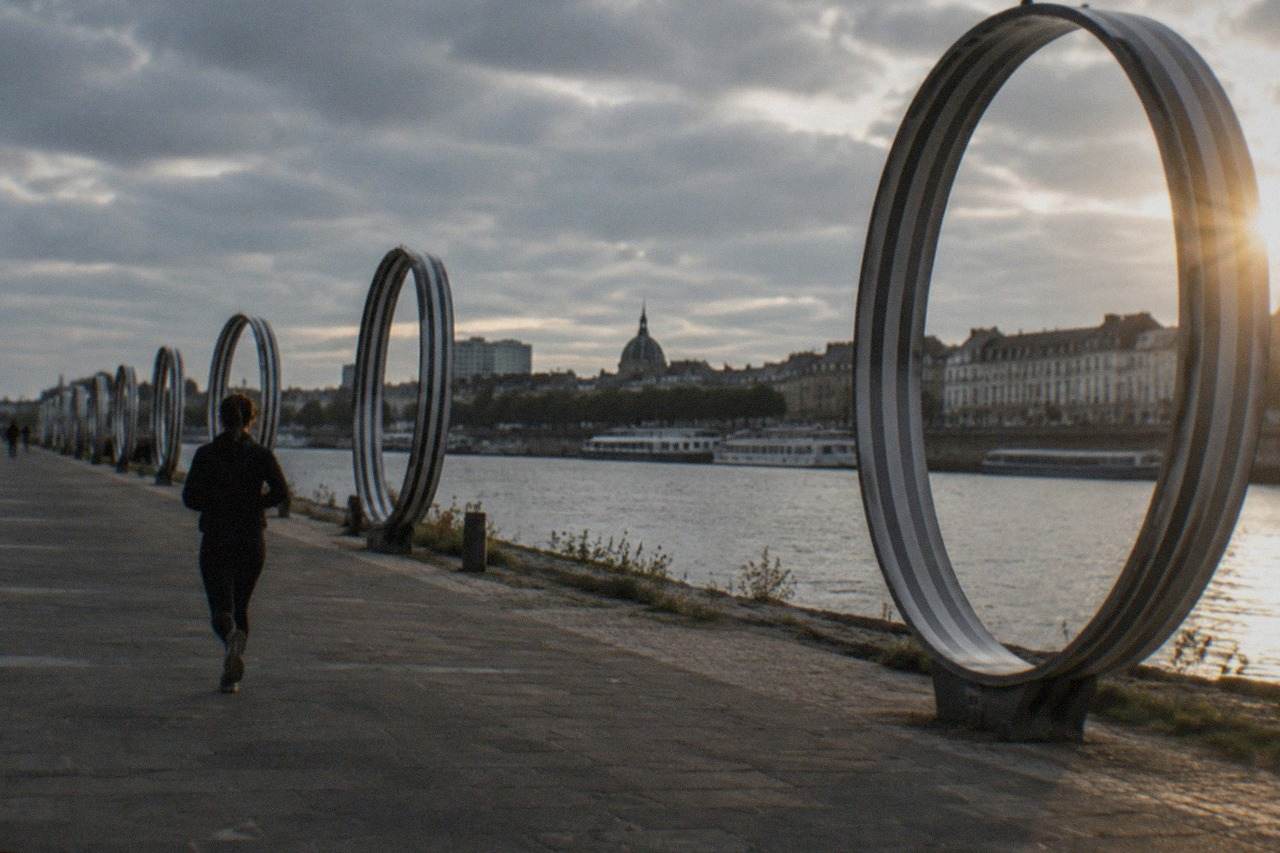
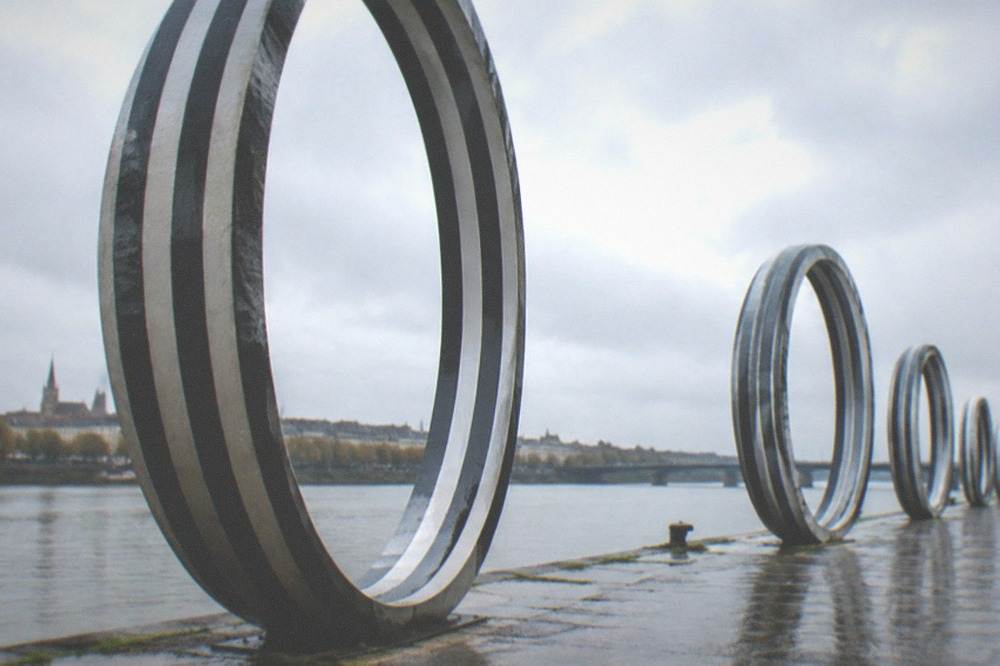
The Anneaux de Buren are a line of sculptural rings by the French artist Daniel Buren on the Quai des Antilles, on the Île de Nantes in western France, and they have become one of the most photographed sights on the Loire riverfront in Nantes.
Short answer
The Anneaux de Buren are a public artwork by Daniel Buren installed on the Quai des Antilles on the Île de Nantes in Nantes, France, part of the contemporary art trail that runs along the Loire. They sit on a free, always-open riverside promenade close to the Machines de l'île, the Hangar à Bananes and the Trentemoult river shuttle, which makes them an easy stop on any walking route around the island.
The Anneaux de Buren are a public artwork by the French artist Daniel Buren, installed on the Quai des Antilles on the Île de Nantes in Nantes, a city in the Loire-Atlantique department of the Pays de la Loire region of western France. The rings line the Loire's south bank where the old shipyards used to stand, and they now serve as one of the most recognisable landmarks of the island's regenerated waterfront. There is no ticket, no gate and no queue: the promenade they stand on is a free public space, open at any hour, and it links directly to the island's two biggest draws, the Machines de l'île and the Hangar à Bananes. This guide sets out what the rings are, how to reach them by tram or river shuttle, what surrounds them, and how to fold them into a day on the island.
The site facts on file for this artwork are thin on numbers, which is itself worth saying plainly: this is a free, unstaffed outdoor installation, and the city's official visitor channels describe it through the wider Île de Nantes story rather than with an entry tariff or opening hours of its own. What the sources do give is context. The rings belong to the same island regeneration that brought the Machines de l'île, inaugurated with the Grand Éléphant in 2007, and the same cultural programme, Le Voyage à Nantes, that paints a green line roughly 20 km through the city each summer. For everything practical, prices and hours below come from verified operator and Métropole pages.
What Are The Anneaux De Buren In Nantes?
The Anneaux de Buren are a sculptural installation by Daniel Buren, the French conceptual artist known for striped public works, standing on the Quai des Antilles on the Île de Nantes in Nantes, France. They were created as part of the island's cultural regeneration following the closure of its shipyard land, and they act as both an artwork and a piece of street furniture on a promenade that stays open to the public day and night. No ticket is needed and no guided visit exists for the rings alone.
Buren's career is built on a single repeated motif, the vertical stripe, usually in two colours, applied to whatever surface or structure his work takes. Public commissions are where that motif has had its widest audience, and the Nantes rings belong to that strand of his practice: art placed not in a gallery but on a working quay, where people encounter it by accident as much as by intention. The rings change character with the light and the tide, and the Loire in front of them shifts between mudflats and high water, which gives photographers a different picture every day.
What makes the piece work as a landmark is its setting. The Île de Nantes was, for most of the 20th century, an industrial island of shipyards, warehouses and docks. The regeneration that followed turned the western end into a cultural district, and the rings mark the spot where that story is most visible: heritage cranes and shipyard buildings sit within a short walk of the Machines de l'île, the Carrousel des Mondes Marins and the Hangar à Bananes. The rings sit roughly in the middle of that run, which is why almost every walking route across the island passes them.
Where Exactly Are The Rings And How Do You Reach Them?
The rings stand on the Quai des Antilles, on the northern riverbank of the Île de Nantes, in Nantes in western France, a few minutes' walk west of the Machines de l'île and east of the Hangar à Bananes. The nearest tram stop on the Naolib network lies on the island's spine, and the Navibus N1 and N2 river shuttles both serve the north bank of the island from the city centre and from Trentemoult on the south bank.
Getting there is genuinely simple, and the verified fare table below makes it easy to plan the cost. A single Naolib ticket at 1.80 EUR covers an hour of travel across trams, buses and the Navibus river shuttles, and the whole network runs free for everyone from midnight Saturday to 23:59 Sunday, with one exception: the airport shuttle always costs 10 EUR and is never included. A 24-hour ticket at 6.80 EUR, or 15 EUR for a group of four, suits a day built around the island.
The river approach is the one most worth taking. The Navibus N1 runs from the Gare Maritime by the city-centre quays to Trentemoult Sablières on the left bank, and since 12 November 2025 the N2 has linked the Hangar à Bananes and Bas-Chantenay to Trentemoult as well, using a new 46-metre pontoon at Trentemoult and a 140-space park-and-ride on that side. Both shuttles take ordinary Naolib tickets, so a single validated fare covers the crossing. Arriving by water gives you the rings and the island skyline as a single view, with the cranes of the old Dubigeon yards in the distance.
| Option | Price | What it covers |
|---|---|---|
| Naolib 1-hour ticket | 1.80 EUR | Trams, buses, Navibus shuttles and TER trains inside the métropole for one hour |
| 10-pack of 1-hour tickets | 17.80 EUR | Ten single journeys, validated one at a time |
| 24-hour ticket | 6.80 EUR | Unlimited network travel for one day |
| 24-hour ticket, 4 people | 15 EUR | One day of travel for a group of four travelling together |
| Weekend travel | Free | Saturday 00:00 to Sunday 23:59 for everyone, airport shuttle excluded |
| Airport shuttle | 10 EUR | Always charged, including weekends, valid one hour on the network |
A guided walk is the other easy way to anchor the rings in the island's story, since the artwork makes most sense with the shipyard history attached to it.
What Do The Anneaux De Buren Look Like, And What Makes Them Worth Visiting?
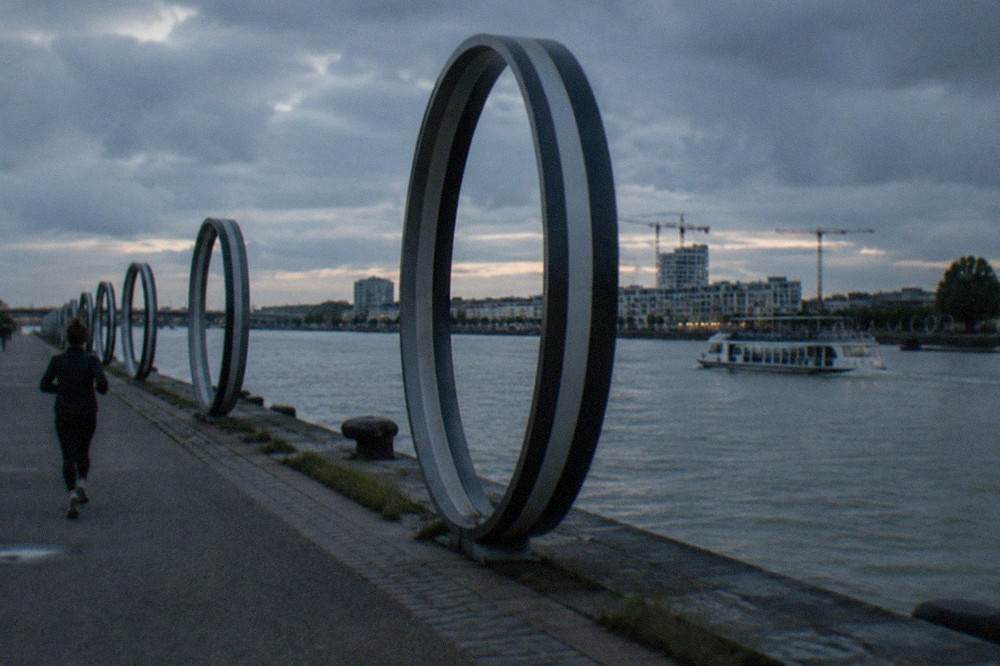
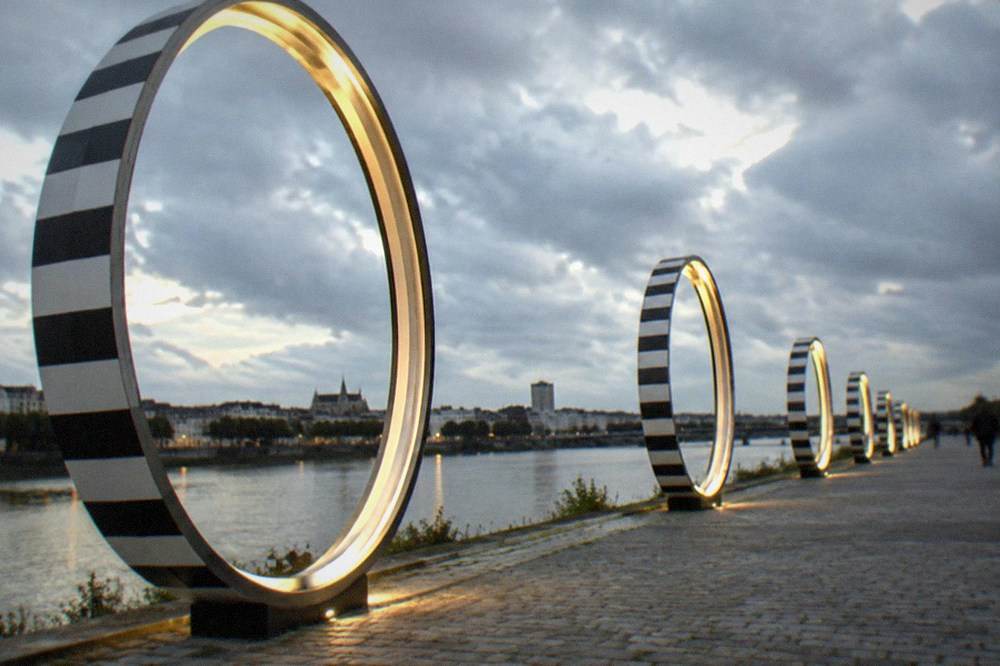
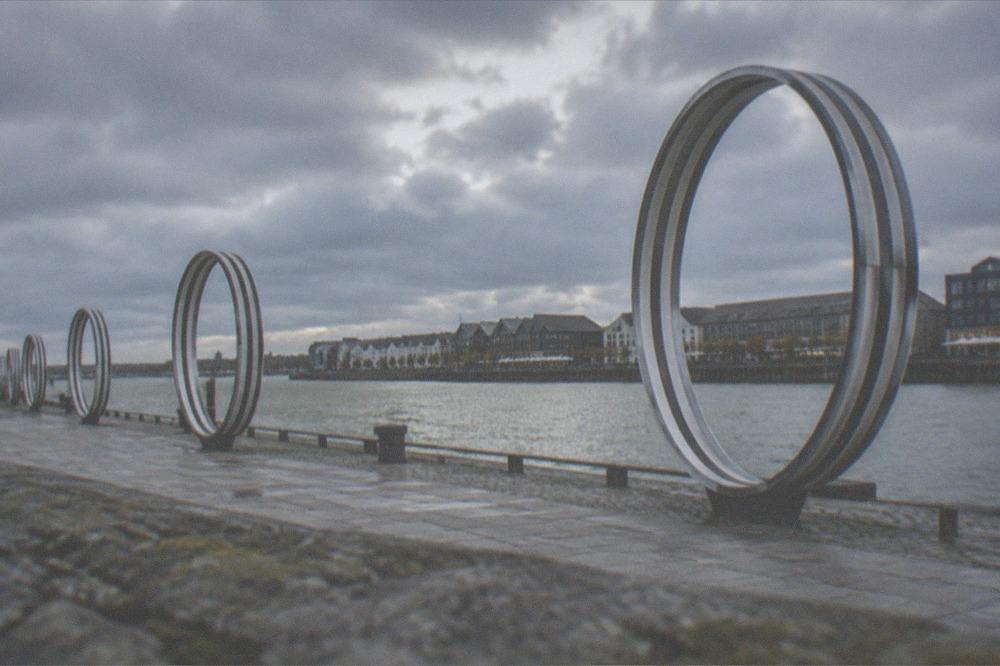
The rings are a repeated series of circular forms set along the quay, striped in the manner that defines Buren's work, and scaled so that people walk between and around them rather than viewing them from behind a barrier. The effect is architectural as much as sculptural: they frame the Loire, the cranes and the opposite bank in slices as you move, and at night the riverside lighting turns them into a lit corridor along the water. There is nothing to pay and nothing to book, only the walk itself.
Photographers should plan around the light. The quay faces north across the river, which means the rings are lit softly in the morning and backlit in the late afternoon, when the Trentemoult housefronts across the water catch the evening sun and the rings go to silhouette. The tide matters too: the Loire at Nantes is tidal, and the river can sit low between the quays or fill them edge to edge, as it did dramatically in February 2026 when it passed 8 metres at the Pont Anne-de-Bretagne for the first time in about 15 years, closing low-lying riverside spaces including, on the verified Métropole pages, the Mémorial de l'abolition de l'esclavage during floods.
The honest planning note is that the rings are a short stop, not a half-day. A short stop of fifteen minutes to half an hour is typical, longer if the weather invites sitting on the quay with the view. The reason to come is that they sit inside a dense cluster: you do not travel to the Île de Nantes for the rings alone, you fold them into a loop that also takes in the Machines, the Hangar à Bananes and the crossing to Trentemoult. That loop is, in the view of this desk, one of the best free afternoons in the city, and it needs no car and no booking except for the Grand Éléphant ride, which the operator advises booking in advance because slots sell out.
For travellers who like their sightseeing structured, a short local-led walk covers the riverside core of the city in about an hour and pairs well with a self-guided afternoon on the island.
How Do The Rings Fit Into The Île De Nantes Story?
The rings belong to the cultural transformation of the Île de Nantes, the shipyard island that now hosts the Machines de l'île, the Carrousel des Mondes Marins, the Hangar à Bananes and the HAB Galerie in Nantes, France. The island's regeneration has been driven since 2011-2012 by Le Voyage à Nantes, whose summer edition in 2026, themed around Earth, ran from 4 July to 6 September, and by the Estuaire art trail, which lists 33 works across 23 sites between Nantes and Saint-Nazaire.
The island's fourth planning phase is under way, with a new urban team in place since 2025 and a 10-hectare Loire park planned with its first part around 2030, alongside the Jardins de l'estuaire programme running 2024 to 2027 and the Jardin du rail opening in 2026. For a visitor, that translates into a district that is visibly mid-construction: new planting and public spaces arrive each year, and some quays still read as industrial ground. The rings sit comfortably in that mix, part permanent landmark, part work in progress, much like the island itself.
Two recent changes on the island are worth knowing before you plan. First, the Frac, the regional contemporary art fund, closed its Hangar à Bananes exhibition site in spring 2025 after a roughly 40% regional funding cut, its last exhibition having ended in January 2025; the HAB Galerie remains active and hosted the INTERSTELLAR exhibition from 23 May to 27 September 2026. Second, the evening and nightlife offer around the Hangar à Bananes keeps growing, with a bar-comedy-club venue reported as a new addition in 2026, which means the rings' stretch of quay now has life after dark rather than emptying at dinner time.
The neighbouring cluster is what turns a short artwork visit into a full day out, and a local-led introduction is the quickest way to get the island's story in one go.
| Sight on or beside the island | What it is | Entry |
|---|---|---|
| Machines de l'île, Galerie des Machines | Working machine workshop and gallery, Île de Nantes | 12 EUR full, 8 EUR ages 4-12 |
| Carrousel des Mondes Marins | 35-metre marine-world carousel, Île de Nantes | 12 EUR full, 8 EUR ages 4-12 |
| Grand Éléphant ride | 12-metre mechanical elephant, Île de Nantes | 12 EUR full, 8 EUR ages 4-12, book ahead |
| Hangar à Bananes | Bars, restaurants and the HAB Galerie on the western quay | Free to browse |
| Trentemoult | Fishing-village quarter on the south bank, reached by Navibus N1 or N2 | Free, ordinary Naolib ticket for the shuttle |
What Should You Combine With The Rings On A Half-Day Loop?
The strongest half-day loop from the rings runs west along the quay to the Machines de l'île and the Carrousel des Mondes Marins, then continues past the Hangar à Bananes to catch the Navibus N2 across to Trentemoult in Rezé, and returns on the N1 shuttle to the Gare Maritime near the city centre, all in Nantes, France. Every element except the two Machines attractions is free, and the loop can be done on a 6.80 EUR day ticket.
Start at the Machines end if you are riding the Grand Éléphant, because the ride's slots are the one thing on the island that genuinely sells out. The operator's tariff page lists each attraction at 12 EUR full price, 10 EUR reduced for visitors aged 13 to 17, students, jobseekers and disabled visitors with proof, and 8 EUR for children aged 4 to 12, with under-4s free. Two attractions in a day cost 20 EUR full and three cost 29 EUR, and a family group of five with at most two adults gets 15% off same-day purchases. The two hard scheduling facts to check before you go: the Carrousel closed for maintenance from 22 to 25 September 2026, reopening 26 September, and no Grand Éléphant rides run from 2 November 2026 to 28 February 2027 during its maintenance window. Other pages covering the same trip are gathered on Nantes Travel Guide.
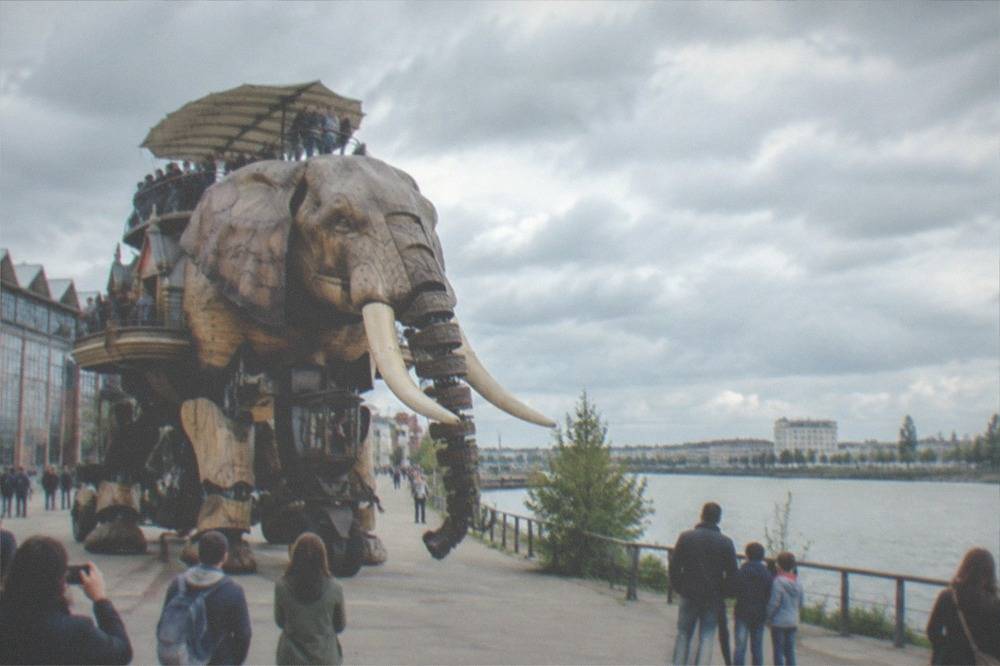
The Pass Nantes changes the arithmetic if you plan to visit several paid sites. Valid from 1 April 2026, a 24-hour pass costs 30 EUR full and 48 hours costs 40 EUR, with a 72-hour version at 49 EUR and a 7-day version at 75 EUR; reduced rates apply for ages 4 to 17, students under 26 and disability card holders. The pass includes unlimited Naolib travel, one return airport shuttle trip, and entry to the Galerie and the Carrousel, but the Grand Éléphant ride is explicitly excluded, which the Machines tariff page states plainly.
| Pass Nantes duration | Full | Reduced | Family, 2 adults and 2 children |
|---|---|---|---|
| 24 hours | 30 EUR | 20 EUR | 80 EUR |
| 48 hours | 40 EUR | 26 EUR | 106 EUR |
| 72 hours | 49 EUR | 31 EUR | 129 EUR |
| 7 days | 75 EUR | 45 EUR | 195 EUR |
A different way to spend the afternoon is playful rather than mechanical: an outdoor escape game themed on Jules Verne, Nantes' most famous literary son, runs through the city's streets and pairs well with a riverside finish.
When Is The Best Time Of Day And Year To Photograph The Rings?
Morning light is the most forgiving for photographing the Anneaux de Buren in Nantes, because the quay faces north across the Loire and the rings frontlight softly before midday, while late afternoon produces silhouettes with the sun behind Trentemoult on the opposite bank. Summer evenings between mid-June and mid-September give the longest golden hours and the busiest riverside atmosphere, and the Quai des Antilles promenade itself is open around the year with no seasonal closure.
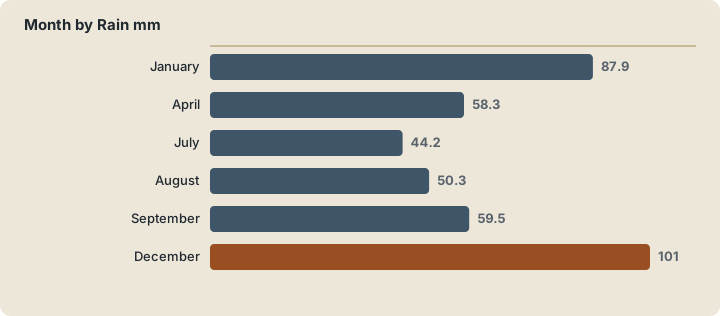
The climate data for the Nantes-Bouguenais station puts the practical frame on this. The 1991-2020 Météo-France normals give a mean maximum of 25.4 °C in August against 9.3 °C in January, with 819.5 mm of rain spread across the year and December the wettest month at 101 mm against July the driest at 44.2 mm. What that means for the quay: spring and autumn give comfortable walking temperatures and thinner crowds, high summer gives long evenings and outdoor bar life at the Hangar à Bananes, and winter gives the rings to you almost alone, with rain gear advisable. Recent years have pushed the extremes, with a new all-time station record of 42.2 °C set on 24 June 2026, so a midday visit in a June-to-August heatwave is worth rescheduling towards the evening.
| Month | Mean maximum °C | Rain mm | Notes for the quay |
|---|---|---|---|
| January | 9.3 | 87.9 | Quietest, wrap up warm |
| April | 16.2 | 58.3 | Comfortable walking weather |
| July | 25.1 | 44.2 | Driest month, longest evenings |
| August | 25.4 | 50.3 | Warmest month, peak terrace season |
| September | 22.4 | 59.5 | Mild and post-summer quiet |
| December | 9.8 | 101.0 | Wettest month, Christmas market season |
If you are timing a whole Nantes trip, the summer edition of Le Voyage à Nantes, which ran 4 July to 6 September in 2026, adds temporary artworks to the permanent collection along the roughly 20 km green line, and the Rendez-vous de l'Erdre jazz and boat festival fills the riverbanks in late August, 24 to 30 August in 2026 with its 40th edition.
Where Should You Eat Near The Anneaux De Buren?
The Hangar à Bananes, a five-minute walk west of the rings along the same quay, is the main eating and drinking cluster on the Île de Nantes in Nantes, France, holding bars, restaurants and venues inside the converted banana-ripening warehouses, while the Machines café and the old-town options across the river at Bouffay cover everything else. Talensac market, the city's main covered market, runs Tuesday to Friday 08:00-13:00 and Saturday-Sunday 08:00-13:30 for self-catering and picnic supplies.
The picnic move is underrated here. The quay has open grass and benches within sight of the rings, and buying at Talensac then walking or tramming to the island costs a fraction of a restaurant lunch. Restaurant pricing in the city, on mid-2026 aggregate data, runs inexpensive for a basic meal, mid-range for a three-course dinner for two without drinks, and modest for a pint of draft beer, with fine-dining tasting menus stretching considerably higher. Those are market aggregates, not promises: every venue sets its own carte.
For the classic Nantes plate, order beurre blanc, the emulsified butter sauce made with shallots and Muscadet that local restaurateurs have been campaigning to have recognised as a protected traditional speciality, usually served with river fish. The sweet equivalents are gâteau nantais, an almond and rum cake whose industrial production by LU has given way to a patisserie revival, and berlingots nantais, the striped tetrahedron sweets first made by the Pinson confiserie, founded in 1895 near the port. A tasting built around the local wine, the Muscadet Experience, runs as a bookable sensory session in the city and makes a good wet-weather or evening complement to a riverside day.
| Meal type | Typical price | Notes |
|---|---|---|
| Inexpensive restaurant meal | ~15 EUR | Bistro, crêperie or market counter |
| Mid-range dinner for two, three courses | ~varies by venue | Without drinks |
| Average three-course dinner per person | ~25 EUR | Good restaurant, aggregate data |
| Draft beer, one pint | ~7 EUR | Domestic lager |
| Talensac market picnic | Market prices | Tue-Fri to 13:00, Sat-Sun to 13:30 |
What Other Free Sights Sit Within Walking Distance?
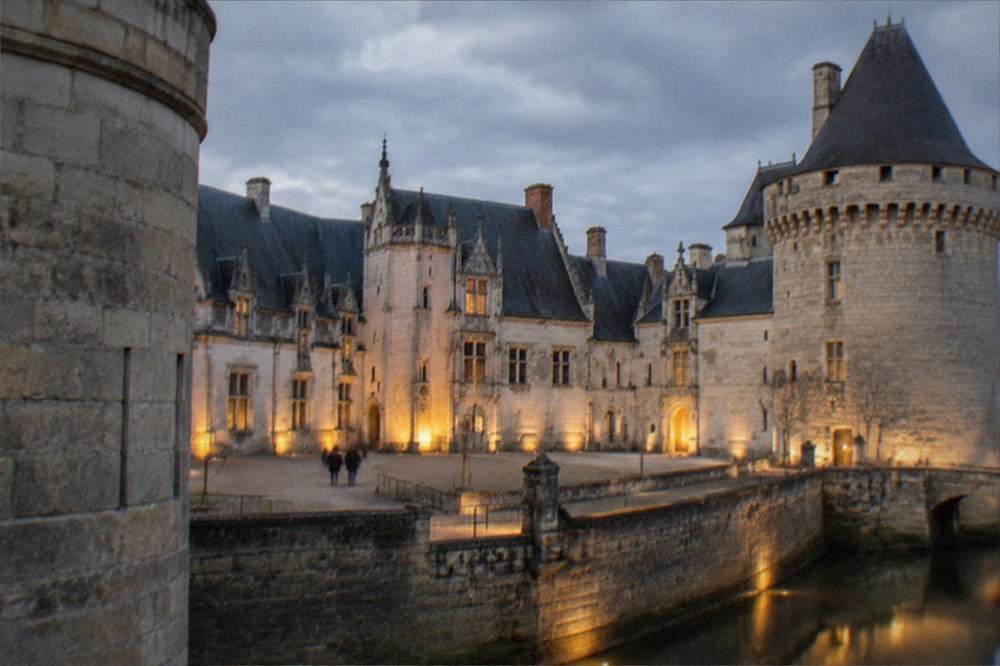
Within a 20-minute walk of the rings in Nantes, France, you can reach the Château des ducs de Bretagne whose courtyard and ramparts are free daily from 08:30 to 19:00, the Passage Pommeraye shopping gallery from 1843, the Jardin des Plantes, the Cathédrale Saint-Pierre-et-Saint-Paul which reopened partially on 27 September 2025 after the 2020 fire, and the free Mémorial de l'abolition de l'esclavage on the Quai de la Fosse.
Crossing to the city side is easiest from the island's northern quays, either on foot over the Pont Anne-de-Bretagne, which the new tram lines 6 and 7 will also use when they enter service at the end of 2027, or by the Navibus. Once across, the old-town core of Bouffay leads up to the cathedral, whose western facade remains under scaffolding with full reopening planned for 2028, and whose restored choir organ has been back in service since the reopening ceremonies, including an inaugural concert on 7 December 2025. The château's free exterior circuit, ramparts and moat garden gives the island view a historic counterweight: the fortress Francis II began rebuilding in 1466, birthplace of Anne of Brittany in 1477, and now home to the Musée d'histoire de Nantes inside the walls.
The full paid-museum picture, with the Pass Musées at 15 EUR for a year of unlimited access to the Musée d'arts, the Musée d'histoire inside the château, the Musée Jules Verne and the Chronographe in Rezé, is covered in the guides linked below. One caution for planners of rainy-day fallbacks: the Muséum d'histoire naturelle has been closed for major works since November 2025 and will not reopen before 2029, so it cannot be counted as a stop on any current itinerary.
Common Questions About The Anneaux De Buren In Nantes
Are the Anneaux de Buren free to visit?
Yes. The rings stand on the public Quai des Antilles promenade on the Île de Nantes in Nantes, France, which is open around the clock with no ticket, gate or booking. Only the nearby paid attractions on the island, principally the Machines de l'île attractions at 12 EUR full price each, carry charges.
Who made the Anneaux de Buren?
The rings are a work by Daniel Buren, the French conceptual artist whose repeated striped motif appears in public commissions worldwide. They were installed as part of the cultural regeneration of the Île de Nantes, the former shipyard island in the Loire at Nantes.
How do I get to the Anneaux de Buren?
Take a Naolib tram towards the Île de Nantes and walk to the Quai des Antilles on the island's north bank, or ride the Navibus N1 or N2 river shuttle, both of which serve the island's north bank and Trentemoult on ordinary Naolib tickets. A 1-hour ticket costs 1.80 EUR, and the whole network is free on weekends apart from the 10 EUR airport shuttle.
What else is near the Anneaux de Buren?
The Machines de l'île and its Grand Éléphant, the Carrousel des Mondes Marins, and the bars, restaurants and HAB Galerie of the Hangar à Bananes all lie along the same quay walk, with the fishing-village quarter of Trentemoult a short river shuttle away on the south bank.
When is the best time to photograph the rings?
Morning gives soft front light on the north-facing quay, while late afternoon silhouettes the rings against the sunset over Trentemoult. Summer evenings between mid-June and mid-September offer the longest light, and the quay is freely walkable year-round.
How long should I spend at the rings?
Fifteen minutes to half an hour covers the artwork itself. Visitors can treat the rings as a stop on a wider island loop that also takes in the Machines, the Hangar à Bananes and the Trentemoult crossing, which fills a relaxed half-day without any transport beyond a tram or shuttle ticket.
The rings are a small thing done well: a free artwork on a working quay, placed so that a whole district's story, shipyard to Machines, is within one riverside walk. Pair them with a Grand Éléphant ride, a Navibus crossing to Trentemoult and a glass of something local at the Hangar à Bananes, and the Île de Nantes gives you a day that few first-time visitors to France's western cities expect to find. For the wider picture of the region, see the Pays de la Loire travel guide on Nantes Travel Guide, or start with what to do in Nantes and the Île de Nantes area guide.
For more on the neighbourhood the rings anchor, read about the Machines de l'île, the Carrousel des Mondes Marins, the Château des ducs de Bretagne and the Nantes cathedral, and see what the Machines de Nantes are explained in full.