What Are The Machines De Nantes?
What the Machines de Nantes are, who builds them, what they cost in 2026, when the Grand Éléphant rides run, and how to reach Les Machines de l'île on the Île de Nantes.
The Machines de Nantes, formally Les Machines de l'île, are a family of giant mechanical animals built and operated on the Île de Nantes, the island in the Loire that once held the city's shipyards, in the Loire-Atlantique department of the Pays de la Loire region of western France. Conceived by the theatre engineers of the company La Machine together with the street-theatre company Royal de Luxe and the designers François Delarozière and Pierre Orefice, the project opened on 30 June 2007 and turned a disused industrial island into a workshop you can actually walk through. Visitors watch sculptors and engineers at work, ride a 12-metre-class walking elephant that sprays water at passers-by, and board a carousel of sea creatures three storeys high. This page answers the question directly: what the Machines are, who makes them, what a visit costs in 2026, and how to plan around the maintenance windows that catch people out.
What Are The Machines De Nantes?
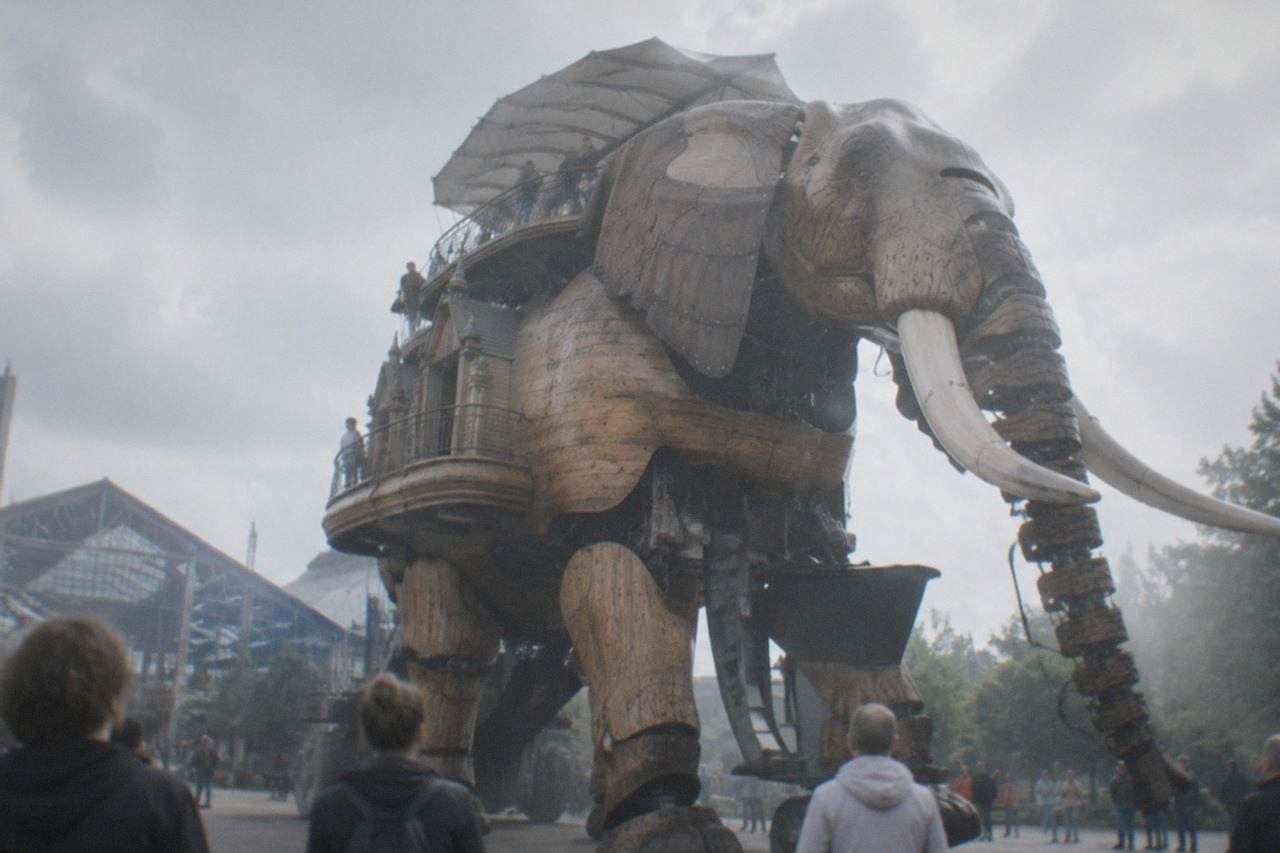
The Machines de Nantes are the mechanical creatures of Les Machines de l'île, a cultural project on the Île de Nantes in western France where theatre engineers build living machines inspired by the imaginary worlds of Jules Verne and Leonardo da Vinci. The site opened on 30 June 2007 with the Grand Éléphant, a walking mechanical elephant, and today groups three paid experiences: the Galerie des Machines workshop, the Carrousel des Mondes Marins and a ride aboard the elephant itself.
The idea grew out of the Nantes street-theatre tradition. Royal de Luxe, the company behind the giant marionettes that parade through world cities, has been based in Nantes since 1989, and its engineers spent years building mechanical machinery for spectacle: elephants, giants, carousel creatures. When the city began redeveloping the shipyard island, it invited those engineers to stay and work in public view. The result is not a theme park in the commercial sense but a "street theatre laboratory", a phrase the project itself uses, where the builders are part of the show.
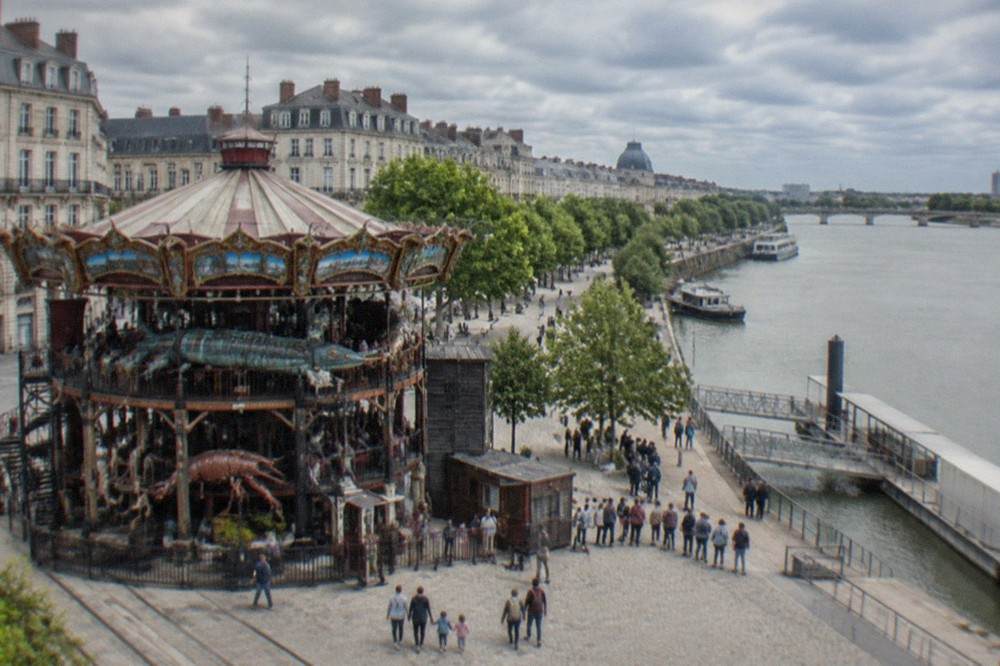
Three experiences make up a visit. The Galerie des Machines is the workshop-gallery: a hangar where machines in progress hang from the ceiling, where keepers walk a mechanical heron on a leash for visitors, and where the test branch of the abandoned Arbre aux Hérons project still stands. The Carrousel des Mondes Marins, added in 2012, is a 35-metre-wide three-level carousel of machines evoking the depths of the sea, the surface and the sky, on the old shipyard basin. The Grand Éléphant is the star: a 48-tonne elephant that carries some 50 riders at a time on a walk along the Loire-side promenade, trumpeting and spraying water from its trunk.
Jules Verne is the thread running through it all. Nantes is the writer's birthplace, born there on 8 February 1828, and the Machines deliberately mine his maritime and mechanical imagination, alongside the inventions of Leonardo da Vinci, the other declared inspiration. For more on the writer's footprint in the city, see our guide to the Jules Verne Museum and our broader answer on what Nantes is famous for.
Who Builds The Machines, And Why Is There No Heron Tree?
The machines are built by La Machine, the Nantes company of designers and engineers founded around the artistic direction of François Delarozière, working in a publicly visible workshop on the island. Royal de Luxe, the street-theatre company based in the city since 1989, is the artistic ancestor of the project, and the two houses share the same philosophy: machines as theatrical characters rather than fairground rides.
The workshop is the part most guides under-sell. In the Galerie you watch leather being stitched onto wooden ribs, counterweights adjusted, and finished machines exercised by their "conductors", the costumed keepers who give each creature a personality in performance. This theatre-of-making is why the project reads differently from a theme park: the process is the attraction.
The famous missing piece is the Arbre aux Hérons, the Heron Tree, planned as a vast steel tree carrying mechanical herons that visitors could ride between its branches. It was definitively abandoned by Nantes Métropole in September 2023 after cost estimates of around 52 million euros rose toward 80 million or more. In December 2025 the company La Machine filed a legal claim against the Métropole seeking damages for the abandonment, a dispute reported in early 2026. What survives on site is the prototype branch: a working section of the tree, included with every attraction ticket, alongside a presentation film and terraces. Any 2026 source describing the Heron Tree as "coming soon" is years out of date.
The island around the Machines is worth the walk in itself, from the old naves of the shipyards to the Anneaux de Buren rings lighting the quay at night; our Île de Nantes area guide covers the whole district.
How Much Do The Machines De Nantes Cost In 2026?
Each of the three paid attractions, the Galerie des Machines, the Carrousel des Mondes Marins and the Grand Éléphant ride, costs 12 euros full price, 10 euros reduced for visitors aged 13 to 17, students, jobseekers and disabled visitors with proof, and 8 euros for children aged 4 to 12, with under-4s free. A two-attraction day package costs 20 euros full and a three-attraction package 29 euros, and a family of five gets 15 percent off individual tickets bought the same day.
The pricing is per attraction, not per site, which is the single biggest point of confusion at the ticket desk. The official tariff page groups it as follows.
| Ticket | Full | Reduced (13-17, students, jobseekers, disabled) | Child 4-12 | Notes |
|---|---|---|---|---|
| Galerie des Machines | 12 EUR | 10 EUR | 8 EUR | Workshop-gallery visit, includes the prototype branch |
| Carrousel des Mondes Marins | 12 EUR | 10 EUR | 8 EUR | Three-level marine carousel ride |
| Grand Éléphant ride | 12 EUR | 10 EUR | 8 EUR | No rides 2 Nov 2026 to 28 Feb 2027 |
| 2-attraction day package | 20 EUR | 17 EUR | 14 EUR | Any two of the three |
| 3-attraction day package | 29 EUR | 25 EUR | 21 EUR | All three, same day |
| Family discount | -15% | -15% | -15% | Group of 5, max 2 adults, same day |
Two things to check before you buy. First, the Pass Nantes, the city's tourist pass priced from 30 euros for 24 hours under the structure valid from 1 April 2026, includes the Galerie and the Carrousel but explicitly excludes the Grand Éléphant ride, so elephant fans still need a separate ticket. Second, the elephant regularly sells out in high season and advance booking for it is recommended by the site itself, while the other two attractions are usually available on the spot. Allow real time: the Galerie alone comfortably fills an hour, and the full three-attraction circuit with the walk between them is a half-day proposition.
Budget planners should also read our Nantes on a budget and Pass Nantes pages, which compare the pass against paying individually for a typical two-day visit.
If you want the Machines explained rather than just ridden, a guided walk of the city that includes the island frames the shipyard history around what you are looking at.
When Can You Ride The Grand Éléphant In Nantes?
The Grand Éléphant runs daily through the main season, with slots from early September to 16 October operating Tuesday to Friday between 10:15 and 15:45, but it stops entirely for its long winter maintenance from 2 November 2026 to 28 February 2027, and the whole site closes annually for part of January. The Carrousel closed for its own maintenance from 22 to 25 September 2026, reopening 26 September, so short technical pauses are normal and worth checking against the site's own hours page before you travel.
The elephant maintenance window is the one that catches visitors out. A February 2027 arrival in Nantes, a common half-term choice, means no elephant, though the Galerie and Carrousel generally run through the winter months with reduced seasonal hours. Last admission to any attraction is 45 minutes before closing, and the site's hours shift by season, with longer summer openings and shorter off-season ones, so the same visit can feel very different in July and in January.
Planning around the closures is simple enough with the table below, which gathers the practical windows in one place.
| What | When it runs | When it does not |
|---|---|---|
| Galerie des Machines | All year, seasonal hours | Part of January (annual closure) |
| Carrousel des Mondes Marins | All year, seasonal hours | 22-25 Sept 2026; part of January |
| Grand Éléphant rides | Daily in season; Tue-Fri 10:15-15:45, Sept to 16 Oct 2026 | 2 Nov 2026 to 28 Feb 2027; part of January |
| Prototype branch of the Heron Tree | Included with any attraction ticket | Follows the Galerie's closures |
| Weather or heat closures | Possible temporary pauses | Announced by the site |
The other seasonal factor is the tram. Access to the Machines was affected by works on tram line 1 at the Chantiers navals stop between mid-June and the end of August 2026, a reminder that the island's transport links are under continuous works while the new tram lines 6 and 7 are built for delivery at the end of 2027. None of this closes the Machines; it just means checking the journey on the day.
How Do You Get To The Machines De Nantes?
The Machines de l'île sit on the western end of the Île de Nantes, reached by tram line 1 to the Chantiers navals stop, a short walk from the Parc des Chantiers along the Loire. The Nantes tram network runs three lines over 45.6 kilometres with 84 stations, a single Naolib ticket costs 1.80 euros and is valid one hour, and weekend travel on the whole network is free from Saturday midnight to Sunday 23:59.
From the city centre the crossing of the Loire is the pleasure of the journey: the ramparts of the Château des ducs de Bretagne give way to the quay, and the elephant's route is visible from the far bank. The site sits among the old shipyard halls of the island, the very buildings whose closure left the island free for cultural reuse, which is why the Machines feel so rooted here rather than imported.
The practical footnote is the tram works noted above: during summer 2026 the Chantiers navals stop was impacted by line 1 works, and similar disruption will recur as lines 6 and 7 take shape toward the end of 2027. The island is entirely walkable from the city centre in roughly half an hour along the quays, a route our Nantes walking guide and the answer to whether Nantes is a walkable city both cover in more detail. Cyclists can follow the Loire-side paths, and the city's river shuttle network also calls at island-linked stops on the Loire.
A short guided walk is the easiest way to have the shipyard story explained on the spot, and the 60-minute local walk covers it:
Check availability for the Local Walk on the operator's live listing.
Beyond the Machines, the island rewards an extra loop: the Jardin des Plantes-style green spaces of the Île de Versailles sit north on the Erdre, and the wider park-and-garden network is mapped in our parks and gardens guide. For anyone pairing the island with the rest of the city, a longer guided experience or a food-led walk through the old town both work well as a same-day combination, and the choices below cover the most reliable options for 2026.
Common Questions About The Machines De Nantes
What are the Machines de Nantes?
They are giant mechanical animals built by the company La Machine in a public workshop on the Île de Nantes in western France, a project opened on 30 June 2007 with the Grand Éléphant and inspired by Jules Verne and Leonardo da Vinci. The three paid experiences are the Galerie des Machines workshop, the Carrousel des Mondes Marins and a ride on the elephant itself.
Where exactly are the Machines de Nantes?
On the western end of the Île de Nantes, the island in the Loire that held the city's former shipyards, next to the old naves of the Parc des Chantiers. Tram line 1 serves the site at the Chantiers navals stop.
Can you ride the elephant at the Machines de Nantes?
Yes, in season. The Grand Éléphant carries riders along the Loire-side promenade, and each ride ticket costs 12 euros full price, 10 euros reduced or 8 euros for children aged 4 to 12. There are no rides from 2 November 2026 to 28 February 2027 for maintenance, and the site advises booking elephant slots in advance because they often sell out.
Is the Heron Tree at the Machines de Nantes?
Only its prototype. The full Arbre aux Hérons project was abandoned by Nantes Métropole in September 2023 after costs rose from around 52 million euros toward 80 million or more, and La Machine filed a legal claim against the Métropole in December 2025. The working prototype branch, a film and terraces are included with every attraction ticket.
How long does a visit to the Machines de Nantes take?
The Galerie alone fills about an hour, the Carrousel visit around 45 minutes with queuing, and the elephant ride is a short loop with a boarding queue. A full three-attraction visit, with the walking between them, is realistically a half-day, and last admission to any attraction is 45 minutes before closing.
Are the Machines de Nantes good for children?
Yes, they are among the most child-friendly sights in the city. Children aged 4 to 12 pay 8 euros per attraction instead of the 12 euro full price, under-4s enter free, and a family of five gets 15 percent off same-day individual tickets. The Galerie's hands-on machine demonstrations and the Carrousel's three moving levels are designed for exactly this audience.
The Machines de Nantes remain the clearest single example of what this city does best: taking the bones of its industrial past, in this case a shipyard island, and filling them with working imagination. Book the elephant slot early, check the maintenance windows before you travel, and leave time for the workshop itself, because watching the next machine being born is half the show. For everything else in the city, start with the full Nantes Travel Guide and our deeper guide to Les Machines de l'île.