How Tall Is The Elephant In Nantes?
The Grand Éléphant at Les Machines de l'île in Nantes, France stands 12 metres tall. Ride prices, maintenance closures for 2026 and 2027, and why Nantes built a mechanical elephant at all.
The Grand Éléphant at Les Machines de l'île, on the Île de Nantes in western France, is the single most photographed object in the city, and its size is the first thing every visitor asks about. The machine's own communications give its height as 12 metres, which makes it taller than a three-storey house and roughly a tenth the height of the Tour Bretagne, the tower whose antenna tip reaches 144 metres. This page answers the height question directly, then covers what a ride costs in 2026, when the elephant stops walking for maintenance, and how a former shipyard island ended up with a mechanical pachyderm in the first place.
How Tall Is The Elephant In Nantes?
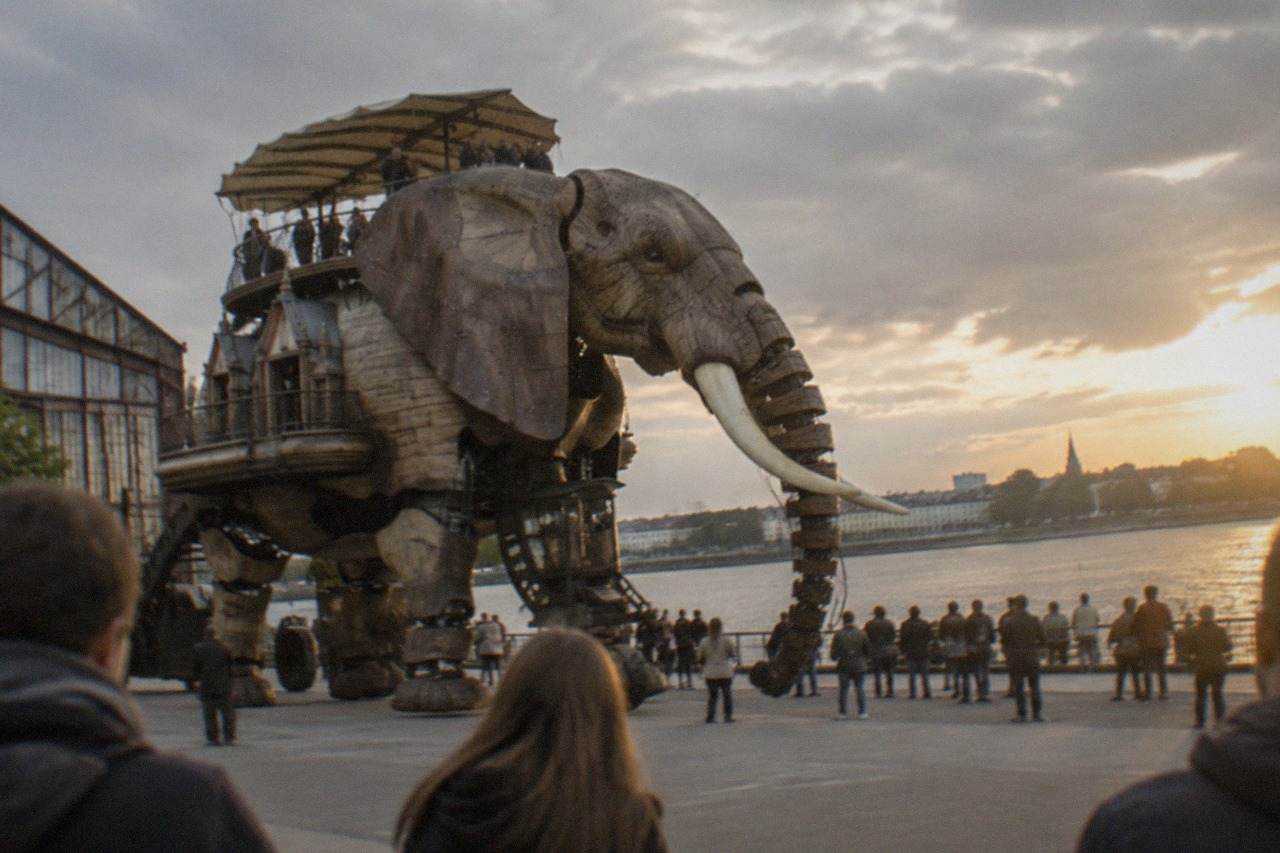
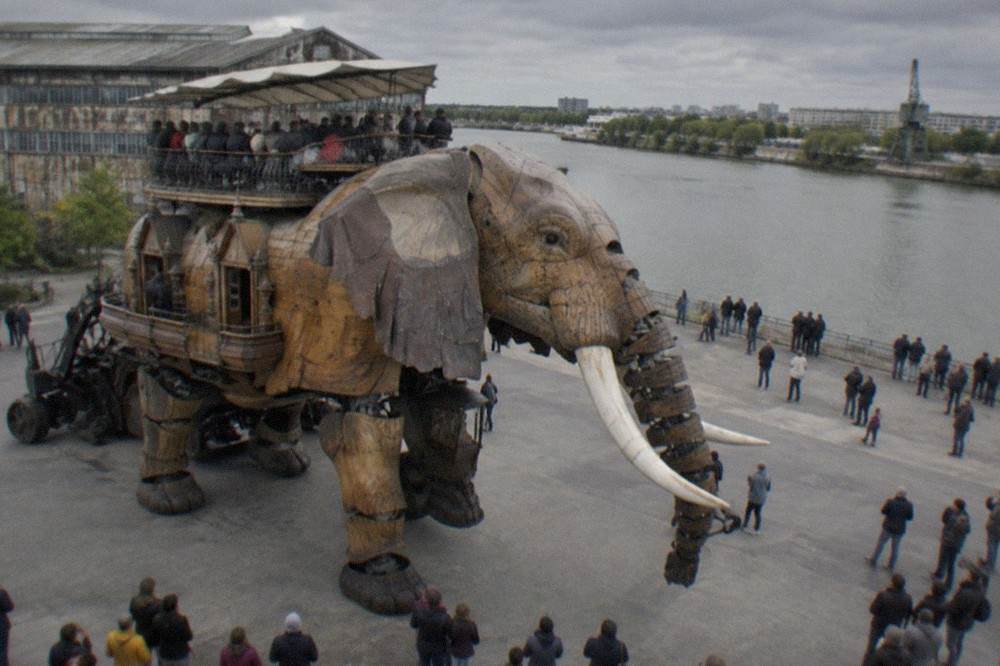
The Grand Éléphant at Les Machines de l'île in Nantes stands 12 metres tall, roughly the height of a four-storey building, and it is a working machine rather than a statue. It walks a loop along the Île de Nantes, sprays water from its trunk and carries passengers on its back. It has done so since Les Machines de l'île opened on 30 June 2007.
The elephant was built by the engineers of La Machine, drawing on the street-theatre tradition of Royal de Luxe, based in Nantes since 1989.
Twelve metres is the figure the attraction itself uses, and it is worth holding it up against the city around it for a sense of scale. The towers of the cathedral, the tallest structure in the historic centre, stand well above it, as does the Tour Bretagne across the river, whose roof sits at 120 metres and whose antenna tip reaches 144 metres. But nothing else on the Île de Nantes comes close. The warehouses of the Hangar à Bananes, a short walk down the quay, are large in footprint rather than height, so the elephant dominates the island's flat, open former shipyard landscape whenever it moves.
The height is also functional rather than showy. A machine this tall needs the internal volume to house the hydraulics, the pumps for the trunk's water spray and the staircase-style access the crew uses before each departure. Passengers board at deck level, sit in an open howdah on the elephant's back, and look down on the crowd from about the height of a first-floor balcony. That viewpoint is a large part of why the ride sells out: the operator's live listing manages ticketing, and advance booking is the standard advice in peak season because walk-up slots for the elephant regularly go early.
Where To See The Grand Éléphant In Nantes
The Grand Éléphant lives at Les Machines de l'île, the attraction complex on the Île de Nantes, the island in the Loire that once held the city's shipyards. The site sits at the western end of the island near the Chantiers navals tram stop, and the elephant walks a fixed outdoor circuit from there. You do not need a ticket to watch it pass: only riding on its back requires one, and the machine is visible from the surrounding quays free of charge.
Watching costs nothing, which is why the quays fill up whenever a departure is due. The elephant's route keeps it in the open along the old shipyard avenue, so the spray from its trunk and the steam from its flanks are the free show, and many visitors plan a whole loop of the island around catching it. For the ride itself, and for the two indoor attractions that share the site, the pricing structure is per machine, which surprises people expecting a single site ticket.
| Attraction at Les Machines de l'île (2026) | Full price | Reduced (13-17, students, jobseekers, disabled visitors) | Child 4-12 | Under 4 |
|---|---|---|---|---|
| Grand Éléphant ride | 12 EUR | 10 EUR | 8 EUR | Free |
| Galerie des Machines visit | 12 EUR | 10 EUR | 8 EUR | Free |
| Carrousel des Mondes Marins | 12 EUR | 10 EUR | 8 EUR | Free |
| Day package, 2 attractions | 20 EUR | 17 EUR | 14 EUR | Free |
| Day package, 3 attractions | 29 EUR | 25 EUR | 21 EUR | Free |
The family discount of 15 percent applies to groups of five with a maximum of two adults, on the same day. These are the till prices charged on site in euros; anything shown in a different currency on a booking panel is the platform's own conversion for your market, and the two should never be blended. The Galerie des Machines, next to the elephant's departure point, holds the prototype machines and the workshop where new ones are built, so even visitors who skip the ride usually pair the free outdoor spectacle with a Galerie ticket.
A practical way to reach the island is tram line 1 to the Chantiers navals stop, though note that works on that stop ran through mid-June to the end of August 2026, so checking the Naolib network pages before travelling is wise. The island rewards slow exploration: the Machines de l'île explained in full covers the rest of the site, and the question of where the mechanical elephant is kept in Nantes goes deeper into its circuit and departure points.
How Much Does It Cost To Ride The Elephant In Nantes?
A ride on the Grand Éléphant costs 12 EUR at the full 2026 tariff, the same price as a visit to the Galerie des Machines or the Carrousel des Mondes Marins, with reduced tickets at 10 EUR and child tickets at 8 EUR. A two-attraction day package costs 20 EUR and a three-attraction package 29 EUR, which is cheaper than buying separately. The Pass Nantes tourist pass covers the Galerie and the Carrousel but explicitly excludes the elephant ride itself.
That Pass Nantes exclusion is the detail that catches the most people out. The pass, priced from 30 EUR for 24 hours to 75 EUR for seven days at rates valid from 1 April 2026, bundles unlimited Naolib transport, one airport shuttle return and one entry per partner site, including the Galerie and the Carrousel. The elephant, however, is listed as not included, so even pass holders who want the ride buy it separately at the till price. For a family weighing the maths, the three-attraction package often works out better than a pass plus a ride, depending on what else the pass covers that day.
Timing matters as much as price. The elephant does not run year-round without interruption, and the maintenance calendar is published on the attraction's own hours page.
| Closure window at Les Machines de l'île | Dates | What is affected |
|---|---|---|
| Carrousel maintenance | 22-25 September 2026 | Carrousel des Mondes Marins closed, reopens 26 September 2026 |
| Elephant winter maintenance | 2 November 2026 to 28 February 2027 | No Grand Éléphant rides at all |
| Annual January closure | January each year | Whole site closed for the season |
The winter window is the one that matters for trip planning. Anyone visiting between early November 2026 and the end of February 2027 will find the Galerie and, outside January, the Carrousel running, but the elephant itself off its circuit for maintenance. Visitors who want the full three-machine experience should aim for spring through October, with the caveat that the September 2026 Carrousel closure shows how short maintenance stops can appear with little notice, so the operator's own hours page is the final word before you travel.
Bookable products render their own live prices and ratings through the panels on this page, and a private guide is one way to see the island without managing the logistics yourself. For travellers deciding how to split limited days, the question of how many days to spend in Nantes usually resolves into one full day for the historic centre and a half day for the island and its machines.
Why Is There A Mechanical Elephant In Nantes?
The elephant exists because Nantes spent two decades deliberately converting its derelict shipyard island into a cultural district, and Les Machines de l'île was its flagship move. The attraction opened on 30 June 2007 on the Île de Nantes, built around the work of La Machine and drawing on the city's Jules Verne heritage. Royal de Luxe, the street-theatre company behind the giant marionettes, had been based in Nantes since 1989, giving the city a ready-made tradition of walking mechanical giants.
The lineage is the part outsiders miss. The giant elephants and marionettes that paraded through cities in France and abroad came from Royal de Luxe, and the Grand Éléphant is the permanent, site-bound descendant of that street tradition: a performance machine with a daily schedule rather than a one-off parade. The literary thread runs through Jules Verne, born on the Île Feydeau in Nantes on 8 February 1828, whose imagined machines gave the attraction its founding brief, alongside the mechanical drawings of Leonardo da Vinci. The Jules Verne connection to Nantes explains why a river port city on the Loire estuary leans so hard into this invented, engineering-driven mythology.
| Year | Event in the machines' history |
|---|---|
| 1989 | Royal de Luxe street-theatre company based in Nantes |
| 30 June 2007 | Les Machines de l'île inaugurated with the Grand Éléphant |
| 2012 | Carrousel des Mondes Marins added to the site |
| September 2023 | Nantes Métropole abandons the planned Arbre aux Hérons |
| December 2025 | La Machine files suit against the Métropole over the abandonment |
The abandoned project is worth knowing about because older guides still describe it as upcoming. The Arbre aux Hérons, a planned 35-metre walking-heron tree structure, was definitively abandoned by Nantes Métropole in September 2023 after cost estimates rose from around 52 million euros toward 80 million, and La Machine filed legal proceedings against the Métropole in December 2025. Only the prototype branch survives, and it is visitable as part of a Galerie ticket, which includes the prototype, a film and the terraces. Nothing taller than the elephant is being built on the island.
For context on the wider island, the former banana warehouse at the western end, the Hangar à Bananes, now holds bars, restaurants and galleries, and the Navibus N2 river shuttle has linked the Hangar with Trentemoult and Bas-Chantenay since 12 November 2025. A visit to the elephant pairs naturally with all of it.
What Else To See Around The Elephant In Nantes
The Grand Éléphant sits inside the largest single concentration of modern attractions in Nantes, so a visit rarely stops at the ride. Within walking distance stand the Galerie des Machines, the Carrousel des Mondes Marins, the Hangar à Bananes with its bars and the HAB Galerie, and the green line of Le Voyage à Nantes threads the island into a city-wide art trail of roughly 20 kilometres. The summer 2026 edition ran from 4 July to 6 September 2026 under the theme of Earth.
Le Voyage à Nantes is the mechanism that turns the whole city into a temporary open-air museum each summer, and the island is a fixed stop on it. In 2026 a 14-metre metal palm tree stood in the moats of the Château des ducs de Bretagne, works filled the cathedral crypts and the Jardin Extraordinaire for the first time, and the HAB Galerie near the Hangar à Bananes hosted the INTERSTELLAR exhibition from 23 May to 27 September 2026. Anyone visiting in the shoulder season misses the summer installations but gets the permanent machines, which run on their own calendar all year.
Beyond the island, the historic core of Bouffay, the Château des ducs de Bretagne with its free courtyard and ramparts open daily from 8:30 to 19:00, and the cathedral, partially reopened since 27 September 2025 with full restoration targeted for 2028, all sit within a short tram ride. The question of what Nantes is famous for pulls these threads together, and Nantes Travel Guide covers the practical layer of passes, transport and timing in depth.
A private custom walk is the flexible option for travellers who want the island, the château and the old town in one coherent day, since the route is built around what you want to see and the pace you keep. The product pages on this site render current prices and ratings from live data, so checking availability through the listing is the reliable way to compare it against a self-guided day.
Common Questions About The Nantes Elephant
How tall is the elephant in Nantes?
The Grand Éléphant at Les Machines de l'île stands 12 metres tall, roughly the height of a four-storey building. It is a moving machine, not a statue, and it carries paying passengers on its back along a circuit of the Île de Nantes.
Can you ride the mechanical elephant in Nantes?
Yes. Rides cost 12 EUR full price at the 2026 tariff, with reduced tickets at 10 EUR and child tickets at 8 EUR, and they can be booked through the operator's live listing. Note that no elephant rides run from 2 November 2026 to 28 February 2027 while the machine undergoes maintenance.
Does the Pass Nantes include the elephant ride?
No. The Pass Nantes covers entry to the Galerie des Machines and the Carrousel des Mondes Marins, but the Grand Éléphant ride is explicitly excluded, so pass holders buy that ticket separately at the on-site till price.
Where exactly is the elephant in Nantes?
It lives at Les Machines de l'île on the Île de Nantes, the former shipyard island in the Loire, at the western end near the Chantiers navals tram stop on line 1. Watching the elephant walk is free; only boarding costs money.
When was the Nantes elephant built?
The Grand Éléphant was inaugurated with Les Machines de l'île on 30 June 2007, built by La Machine, the engineering company that grew out of the street-theatre tradition of Royal de Luxe, based in Nantes since 1989.
Is the elephant running all year?
No. It stops for winter maintenance from 2 November 2026 to 28 February 2027, and the whole site closes each January for its annual break. Outside those windows it runs daily on a seasonal schedule, with last admission 45 minutes before closing.